


Can a Charity Invest Its Money?
Yes, a charity can invest surplus funds, as long as the decision is made with care and serves its charitable purposes.
Being not-for-profit doesn’t mean breaking even, so a charity can hold a surplus in term deposits or other investments and grow it (ACNC investing guide). The Australian Charities and Not-for-profits Commission (‘ACNC’) judges those decisions against Governance Standard 5, in s 45.25 of the Australian Charities and Not-for-profits Commission Regulations 2022 (Cth) (‘ACNC Regulations‘). It requires the charity to take reasonable steps so that its board members, whom the ACNC calls Responsible People, meet a set of duties, and for an investment they come down to five things:
| Duty | What it means for investing |
|---|---|
| Care | Understand the investment and its risks, and get advice if you lack the skills |
| Purposes | Invest in the charity’s best interests and for its purposes |
| Conflicts | Disclose and manage any personal or related party interest |
| Finances | Manage the money responsibly, with controls and records |
| Solvency | Don’t let the charity operate while it is insolvent |
100% Obligation-Free
Speak to one of our Experienced Lawyers Today
What Should You Check Before Investing?
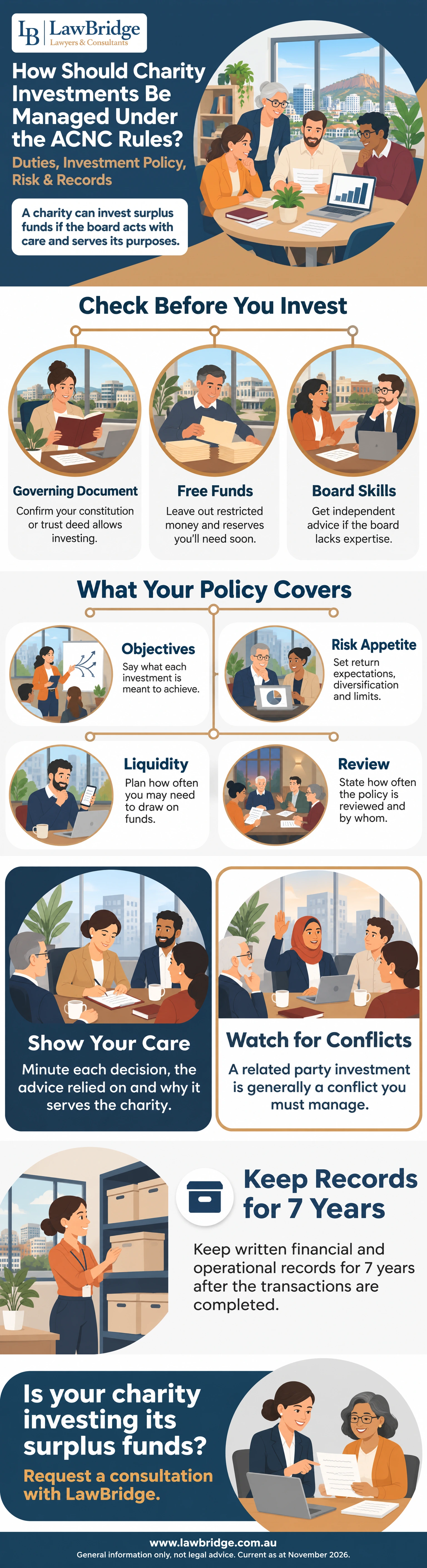
Check that your governing document allows it, that the money isn’t restricted, and that the board understands the risks.
Your constitution, trust deed or a funding contract may allow investing, limit it or say nothing, so read it first. Then check whether any of the money is held in restricted reserves or comes with donor conditions, and whether other laws apply, such as tax, your legal structure, anti-money laundering and counter-terrorism financing, and modern slavery (ACNC investing guide).
Is the Money Free to Invest?
Start with money that isn’t needed soon and isn’t tied to a donor’s conditions. Investing usually aims to earn income, or to preserve or grow reserves the charity doesn’t need straight away, such as savings for building works or equipment (ACNC investing guide). Settle how much your charity should hold in reserves first, because that figure tells you what you can lock away and for how long.
Does the Board Have the Skills?
The board needs to understand both the opportunity and the risks, because a poor investment can cost money the charity needs for its purposes and damage supporters’ trust. Where your Responsible People don’t have those skills, getting independent expert advice is good practice (ACNC investing guide).
Protection for relying on advice: If a Responsible Person relies in good faith on professional or expert advice, after making an independent assessment of it, from an adviser they reasonably believe is competent in that area, the charity is taken to have taken all reasonable steps for its Responsible People to comply with their duties (ss 45.100 and 45.105 of the ACNC Regulations).
What it means: Get the advice in writing, test it against your policy rather than simply adopting it, and record in the minutes why the board accepted it.
What If Your Charity Is a Trust in NSW?
Then the Trustee Act 1925 (NSW) adds its own rules. A trustee may invest trust funds in any form of investment unless the trust instrument expressly forbids it (s 14). In doing so, the trustee must exercise the care, diligence and skill of a prudent person managing other people’s affairs (s 14A). The trustee must also have regard to matters such as the trust’s purposes, diversification, risk, liquidity, tax, inflation and costs, so far as they’re appropriate (s 14C).
Request a Consultation with one of our experienced Lawyers today.
Get Your Initial Consultation
What Should Your Investment Policy Cover?
It should set your objectives, risk appetite, liquidity needs and who decides, and say how often the policy will be reviewed.
An investment policy is the roadmap for how your charity makes investment decisions, scaled to its size and the amount it invests. It’s good practice for any charity that invests, and some must have an investment strategy, such as private and public ancillary funds (ACNC investing guide). A full policy covers:
- the scope of the investments and who is responsible for them;
- your risk appetite, including return expectations, diversification and any restricted types of investment;
- the amount available, the timeframe and the asset classes you allow;
- liquidity, meaning how often you may need to draw on the funds;
- governance, including roles, approvals, committee meetings and reporting;
- performance measures, review intervals and how each decision is recorded; and
- how often the policy itself is reviewed, and by whom.
How Often Should You Review It?
The ACNC doesn’t set an interval, so your policy should say how often it will be reviewed and who does it (ACNC investing guide). A trust in NSW has a floor for the investments themselves. The trustee must review their performance, individually and as a whole, at least once in each year (s 14A(4) of the Trustee Act). An annual review of both is a sensible habit for any charity.
Should You Consider ESG or Impact Investing?
You can, as long as the choice serves your purpose and your legal duties. Responsible investment options may bring higher fees, a narrower choice and different returns, so record why each environmental, social or governance factor matters to your purpose and how it affects returns (ACNC investing guide). Get specialist advice, monitor any firm you appoint to apply the policy, and review the approach regularly.
Example: A health promotion charity might screen out tobacco and gambling businesses, because investing in them would conflict with its purpose (ACNC investing guide).
What it means: Tie each exclusion to your purposes in writing, and estimate what it may cost in returns, so the board can show the choice was made with care.
100% Obligation-Free
Speak to one of our Experienced Lawyers Today
How Much Risk Can a Charity Take?
Only as much as your policy, liquidity needs and purposes allow, and high-risk investments are typically not appropriate for charities.
Choose each investment by what it’s meant to do: preserve capital, grow over the long term, produce income or spread risk. Labels such as “defensive”, “growth” or “speculative” are broad, so weigh any higher-risk investment against your policy, risk tolerance, liquidity needs and reputation, and get independent advice before anything speculative or complex (ACNC investing guide).
Can a Charity Invest in Shares or Crypto-Assets?
Shares are one of the asset classes a charity can hold, if your governing document allows them and they fit your policy. Crypto-assets are legal to invest in, but they are generally considered a high-risk investment, and high-risk investments are typically not appropriate for charities (ACNC crypto-assets guide). If the board still wants to go ahead, document the decision, the risk management and how the assets will be held.
How Do Fees Affect Returns?
Fees come straight off your return, and they include advice fees and the costs of establishing, transacting, administering and switching investments, as well as adviser commissions. Set a required return net of fees and hold your investments to it (ACNC investing guide). For a NSW trust, costs are one of the matters the trustee must consider (s 14C(1)(n)).
What If Losses Threaten Solvency?
A Responsible Person must not allow the charity to operate while it is insolvent, meaning it can’t pay all its debts as and when they become due (s 45.25(2)(g); s 95A of the Corporations Act 2001 (Cth)). So keep enough in liquid funds to meet the charity’s debts, and make sure the board can always tell whether the charity is solvent and how each decision affects its financial health (ACNC managing charity money). If an investment loss puts that in doubt, get insolvency advice straight away.
Request a Consultation with one of our experienced Lawyers today.
Get Your Initial Consultation
How Do Private Benefit and Related Party Rules Apply?
It’s expected that any private benefit from an investment is only incidental, and an investment with a related party is generally a conflict you must manage.
Incidental means an unsought by-product of a decision made in the charity’s best interests, and the board has to use its judgement to keep it that way. Some related party investments shouldn’t go ahead at all, because managing the conflict may mean declining the investment (ACNC investing guide).
Each Responsible Person must disclose any perceived or actual material conflict of interest, including a related party transaction (s 45.25(2)(e)). Once it’s disclosed, manage the conflict before the board votes, and remember that all charities except basic religious charities report related party transactions in their Annual Information Statement (ACNC related party transactions).
100% Obligation-Free
Speak to one of our Experienced Lawyers Today
How Should the Board Make and Record Investment Decisions?
Minute each decision with its reasons, the advice relied on and how it fits your policy, because it’s expected that you can show reasonable care.
It’s expected that your charity can demonstrate that its investment strategy reflects reasonable care and diligence, and that each decision serves its best interests and its purposes (ACNC investing guide). Good records are how you show it.
The business judgement rule: A Responsible Person meets this protection, which relates to the duty of care and diligence, if they made the decision in good faith for a proper purpose, had no material personal interest, informed themselves to the extent they reasonably believed appropriate, and rationally believed it was in the charity’s best interests (s 45.110).
What it means: Let the minutes show each element: the purpose of the investment, the conflicts check, the information and advice considered, and why the board believed it was in the charity’s best interests.
Can You Delegate to a Committee or Investment Manager?
You can, but responsibility stays with the Responsible People, so monitor anyone you appoint and keep the right to end the arrangement (ACNC investing guide). A finance sub-committee can review the reports in more detail and advise the board, and including one or two people who aren’t on the board adds accountability (ACNC managing charity money).
Which Financial Controls Protect Investments?
The basics apply to investments as much as to day-to-day spending. Require more than one person to authorise and complete transactions, set written delegations that say how much each person can approve, protect account access, and keep reviewing the controls (ACNC managing charity money). Together they are the core of how you protect the charity from fraud.
Request a Consultation with one of our experienced Lawyers today.
Get Your Initial Consultation
What Records and Reporting Apply to Investments?
Keep written financial and operational records for 7 years and report through your Annual Information Statement each year.
Your financial records must correctly record and explain the charity’s transactions, financial position and performance (s 55-5 of the Australian Charities and Not-for-profits Commission Act 2012 (Cth) (‘ACNC Act‘)). They must also allow true and fair financial statements to be prepared and audited. Keep them, and the records of the board’s investment decisions, for 7 years after the transactions are completed, because failing to keep them is a strict liability offence with a penalty of 20 penalty units.
What Does Your Charity Report Each Year?
Registered charities lodge an Annual Information Statement (‘AIS’), and medium and large charities also lodge a financial report (ACNC annual financial reports). Size depends on annual revenue (ACNC charity size):
| Size | Annual revenue | Financial report |
|---|---|---|
| Small | Under $500,000 | Not required |
| Medium | $500,000 to under $3 million | Reviewed or audited |
| Large | $3 million or more | Audited |
Both are due within six months of the end of your reporting period, which means 31 December for a 1 July to 30 June year. For the 2026 statement, though, the ACNC has extended the deadline to 31 January 2027 for charities with a 1 July to 30 June year (ACNC due dates).
When Must You Tell the ACNC About a Problem?
Tell the ACNC if a significant breach of the ACNC Act or a governance standard means the charity is no longer entitled to registration (s 65-5). Do it as soon as practicable, and no later than 28 days after becoming aware of it. Whether a breach is significant turns on its nature, significance and persistence, and on keeping contributions applied to the charity’s not-for-profit nature and purpose.
What Should Your Board Do Before It Invests?
Use this checklist:
- Confirm your governing document and any funding contracts allow the investment.
- Set aside reserves and restricted money, and work out what’s free to invest.
- Adopt a written investment policy and decide who approves what.
- Get independent advice if the board lacks the expertise, and assess it.
- Ask every Responsible Person to disclose conflicts before the vote.
- Minute the decision, the advice and the reasons.
- Review performance and the policy at least once a year.
LawBridge’s NFP governance and ACNC compliance lawyers can draft or review your investment policy, check what your governing document allows and advise the board on its Governance Standard 5 duties, working alongside your financial adviser.
Frequently Asked Questions
Quick answers to common questions about charity investments in Australia.
Can a Charity Invest in the Stock Market?
Yes, if its governing document allows it. Shares are one of the asset classes in the ACNC’s investing guidance, and the decision should be weighed against your investment policy, risk appetite and liquidity needs (ACNC investing guide). Get independent advice first if the board lacks investment experience.
Does Every Charity Need an Investment Policy?
No, but some do. Private and public ancillary funds must have an investment strategy, and for other charities a written policy is good practice (ACNC investing guide). It shows the board considered risk, liquidity and purpose before investing.
Is Professional Financial Advice Required?
No, but it’s good practice if the board lacks the skills. Relying on competent advice in good faith, after assessing it yourself, can also bring the board within a protection in the ACNC Regulations (s 45.105). A NSW trustee may pay the reasonable cost of advice out of trust funds (s 14C(2)).
Can a Charity Invest in Cryptocurrency?
It’s legal, but typically not appropriate. The ACNC considers crypto-assets generally high risk, and high-risk investments typically not appropriate for charities (ACNC). If you go ahead, document the decision, the risk controls and how the assets will be held and transferred.
Can a Charity Keep a Surplus?
Yes. Being not-for-profit doesn’t require breaking even, so a charity can retain a surplus and grow it (ACNC investing guide). What matters is that the money is used for the charity’s purposes and not for anyone’s private benefit, so set a reserves policy for it.
Who Is Responsible If an Investment Manager Makes a Loss?
The board still is. A charity can delegate investment management, but overall responsibility remains with its Responsible People (ACNC investing guide). Choose the manager carefully, set clear instructions, monitor performance against your policy and keep the right to end the contract.
How Long Must Investment Records Be Kept?
For 7 years after the transactions are completed. That applies to the charity’s written financial and operational records under s 55-5 of the ACNC Act, and they must be in English or easily converted into English. Keep the board’s investment minutes and advice with them.
Do Charities Have to Invest Ethically?
No, it’s a choice. A charity may consider environmental, social and governance factors, but each one should be linked to its purpose and its legal duties (ACNC investing guide). Record why the factor matters and what it may cost in returns.
What Happens If a Charity Mismanages Its Investments?
The ACNC can act. For a federally regulated charity it can give a formal warning or a direction (s 80-5), and it can revoke registration for non-compliance with a governance standard (s 35-10). Respond quickly to any ACNC compliance review.